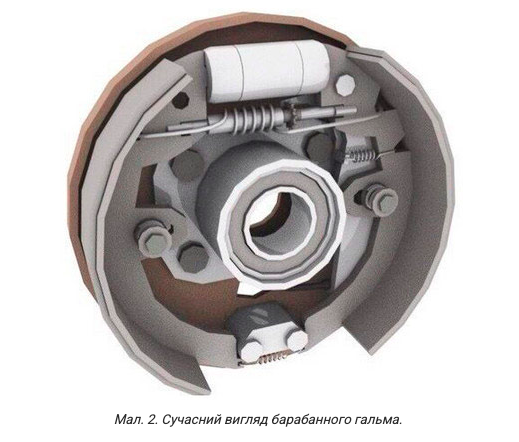
Drum brakes — or, more precisely, their present design developed by Louis Renault in 1902 (Fig. 2) — had simpler versions used a year earlier. In the earliest brakes, the shoes were pressed mechanically using levers and cables. Only from the 1930s were small cylinders with pistons introduced, although this did not apply to all vehicles; some continued using mechanical brakes for several more years, and sometimes two brake cylinders were installed. Brake shoes inside the drum wear out very quickly, and the first brakes required frequent adjustment until the invention of self-adjusting brakes in the 1950s. Drum brakes are also used together with the parking brake, as it turned out to be very difficult to design a parking brake for a disc brake system.
For the driver, a light press on the brake pedal is enough for the leading shoe to engage the drum; after that, the “self-energizing” effect acts as a kind of amplifier. To increase efficiency, drum brakes are equipped with a pair of actuators connected by a rigid linkage or hydraulically: such a brake is more effective due to both shoes being “pulled” along by the drum.
Controlling the braking process becomes more difficult, but the deceleration time is significantly reduced, as is the required force on the brake pedal. This became an important step forward and a prerequisite for introducing brake boosters, since disc brake mechanisms do not have this effect (the brake disc rotates in a direction perpendicular to the direction of the braking force). Once vacuum-type hydraulic brake boosters appeared, the proportionality between pedal force and deceleration became more important, allowing for more precise control of the braking process. Today, drum brakes — if they are used at all — are used for other reasons, and designs with a pair of actuators are practically no longer applied.
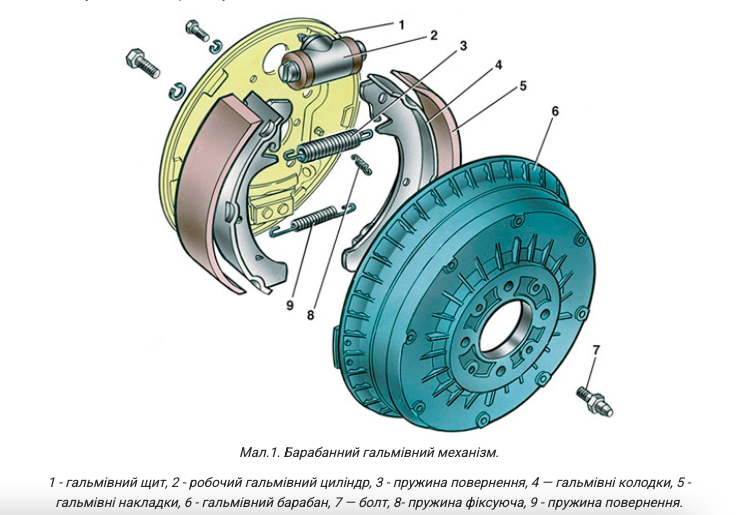
The main elements of a drum brake mechanism (with hydraulic drive) are:
-
brake shoes, which directly perform the braking process and therefore have friction linings (the lining has a high coefficient of friction);
-
the brake drum;
-
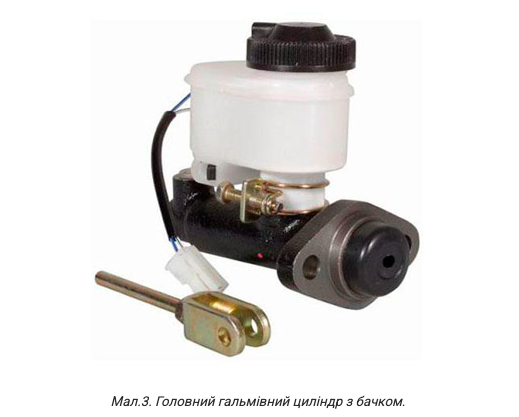
wheel or working brake cylinders, which, under the pressure of the hydraulic fluid, press the brake shoes against the inner surface of the brake drum. They are activated by the brake pedal through the master brake cylinder (Fig. 3). There may be one or two working brake cylinders; two cylinders are used in a duplex brake mechanism, also known as a “twin leading shoe” brake.
All of the above components are mounted on the brake backing plate.
Drum brakes also include the pivot pins (axes) of the brake shoes, springs that hold the shoes in their initial positions and return them only after the driver releases the brake pedal, mechanisms used to adjust the clearance between the brake shoes and the drum (in some cases, these may be separate adjustment mechanisms used when replacing brake shoes during operation), as well as various fasteners.
More details — in відео
Advantages and disadvantages
Without a doubt, drum brakes have their drawbacks: they lose effectiveness during intensive braking due to heating. High temperature causes the drum to expand, and the distance between the shoe and the drum increases, which means the driver must apply more force to brake in time. In addition, drum brakes are prone to sticking after long parking periods, and working brake cylinders often fail when dirt gets inside.
However, when it comes to diagnostics for an unknown malfunction, drum brakes have an advantage. Due to their simple and understandable design and easy access for inspection, combined with inexpensive components that are easy to replace, they are still in considerable demand today.


 En
En