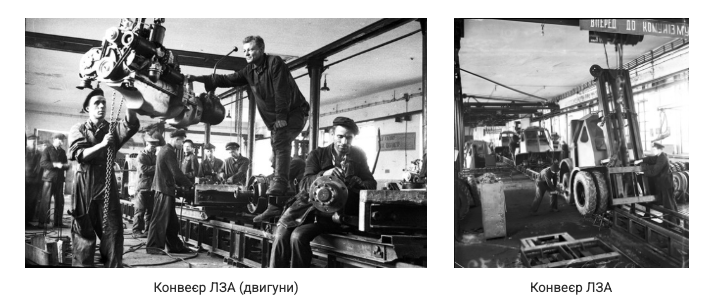
The Lviv Forklift Plant was founded in Lviv in 1948. The plant earned a strong reputation across the former USSR and abroad thanks to the production of forklift models equipped with gasoline engines from the Gorky Engine Plant.
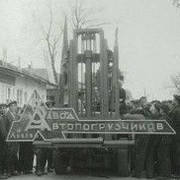
On April 24, 1948, the official opening of the Lviv “Avtonavantazhuvach” Plant (LZA) took place. Throughout its entire history, this enterprise designed, manufactured, and produced more than 30 models of lifting vehicles and mechanisms (including the Lviv forklift models 4014 and 40810). A large number of models and their modifications were produced annually to meet the needs of the national economy (the total annual output reached up to 22.5 thousand units).
History
After the end of the Second World War, the process of establishing and intensively developing all sectors of the national economy began. The economy started to revive. In the difficult post-war period, the country needed various types of equipment (transport, technical machinery, and more). The forklift was one such machine, significantly easing the work of laborers involved in loading, unloading, and installing equipment at enterprises being restored after the war. Therefore, a decision was made to begin forklift production urgently and in the shortest possible time.
The base enterprise for forklift production became an unusual choice for Soviet industry — the “Gazaparat” plant in Lviv, Ukraine (Ukrainian SSR). However, calling “Gazaparat” a base is rather conditional: the site had no workshops suitable for manufacturing forklifts, no special equipment, and — most importantly — no trained personnel. The management of the newly formed “Avtonavantazhuvach” plant, surprisingly, did not have a clear vision of what a forklift should look like.
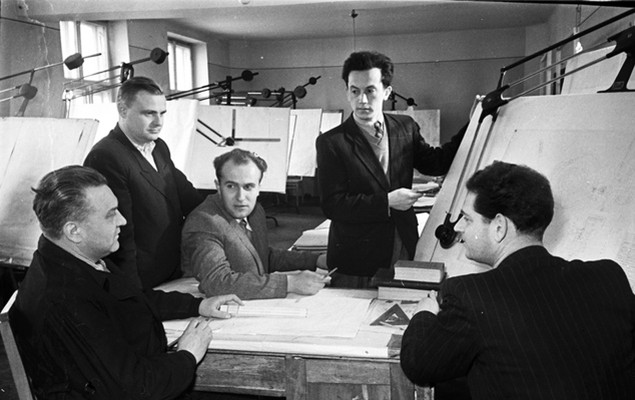
Due to the lack of time, the enterprise was built and developed without a master plan. The organization of work was led by the newly appointed chief engineer of the plant, Oleksandr Kuzovkov — a former employee of the ZIL (Likhachov Plant). A design bureau was established, staffed by specialists from across the Soviet Union, as well as engineers who were graduates of the Lviv Polytechnic Institute. From mid-1948, they were joined by a group of engineers from the “Orgavtoprom” Institute. Through their combined efforts, construction of the “Avtonavantazhuvach” plant began.
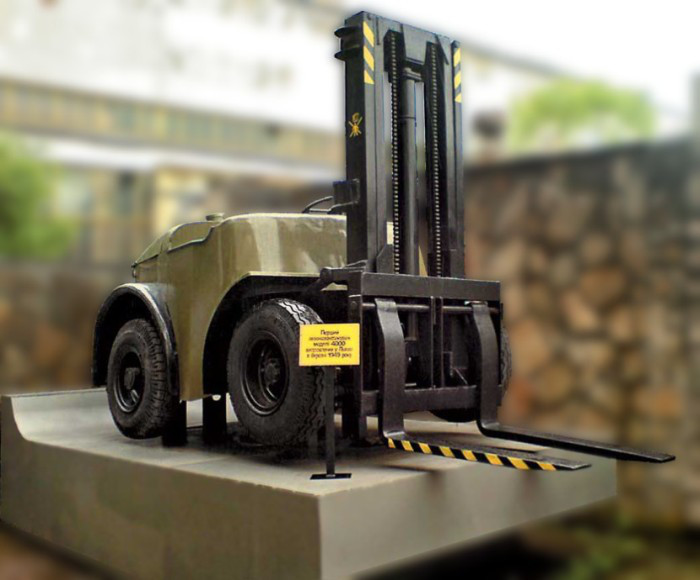
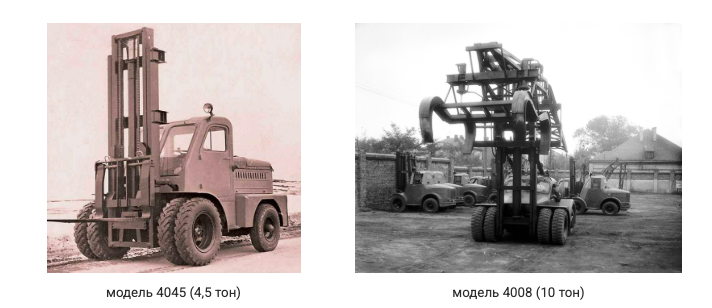
In the same year, 1948, by special order of the USSR State Planning Committee, a universal forklift design was developed in the city of Dnipropetrovsk for the Lviv Forklift Plant. The project was led by automotive designer Hrachov V.A., a laureate of the USSR State Prize, which significantly influenced the design of the future forklift. Due to the lack of time, specialists decided to create a forklift based on already existing automotive units and assemblies. The engine, clutch unit, gearbox, axle, driveshaft, braking system, hood, radiator, and electrical equipment were borrowed from the components of the GAZ-51 truck, while the steering system was based on the ZIS-150 scheme.
The forklift — or more precisely, its 3-ton prototype — was assigned the index 4000. This meant that all subsequent model indices began with the number 4, for example: Lviv forklift model 40814 or model 40810.
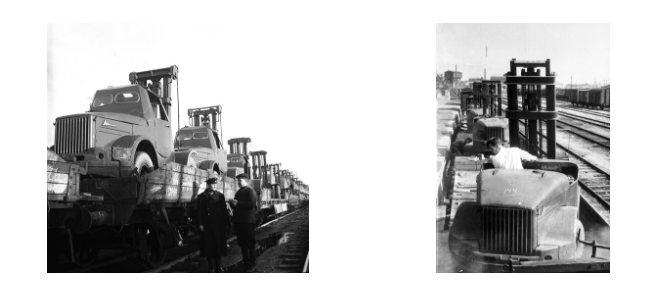
In June 1949, the first debut version of the forklift was assembled and released, and by the end of the year the production plan of 1,000 units had been exceeded.
The continuation of the Lviv forklift’s history has its own specifics. As it turned out, during operation of the released forklifts, many issues arose as a result of the imperfections in the engineering solutions implemented.
The forklift — or more precisely, its 3-ton prototype — was assigned the index 4000. This meant that all subsequent indices of new forklifts began with the number 4, for example: Lviv forklift model 40814 or model 40810.
In June 1949, the debut version of the forklift was assembled and released, and by the end of the year the production plan of 1,000 units had already been exceeded.
The continuation of the Lviv forklift’s history has its own nuances. As it turned out, during the operation of the produced forklifts, many problems arose due to the imperfections of the implemented engineering solutions.
As soon as the first forklifts produced by LZA were distributed across the country, their shortcomings immediately became apparent. The machine turned out to be unstable due to improper weight distribution across the axles, in many cases it slipped and was difficult to control. Steering it was quite challenging — the steering-wheel turning effort was about 50 kg. Overall, the situation did not look good at all.
The project was sent back for refinement to the developer institute in Dnipropetrovsk. Under the supervision of the project author, Hrachov V.A., together with a group of young Lviv specialists, changes were introduced that led to the creation of the 4000M (modernized) model. This produced good results. The forklift became more maneuverable, its cross-country capability improved, a power steering booster was installed, and the driver’s cabin was upgraded (soft seats were added inside). The modernized version of the Lviv forklift was released as early as 1950.
The next — and quite difficult for that time — task for the plant’s team was the development of a 5-ton forklift. The machine developed and proposed by the Moscow Experimental Plant Bureau was more than successful, but to produce it properly, the entire conveyor line needed to be reconfigured.
The problem was successfully solved thanks to a well-thought-out proposal to unify the 3-ton 4000M model: the forklift’s wheelbase was extended, a ZIL axle was installed, and a number of other improvements were made. For the LZA team, 1951 became the year of launching the new 5-ton forklift — model 4003.
Facts, modernization, decline
Over time, new needs emerged. The design bureau (DB), established in 1953, actively engaged both in improving existing models and in developing new forklifts. Following the example of the 4003 model, production of the 4006 model began. It differed from its predecessor by the addition of hydraulic brakes, a disc parking brake, and an automatic hydraulic system valve. At the same time, the installation of additional equipment on the forklift was introduced: a lightweight frameless bucket, a blockless boom, and a timber clamp.
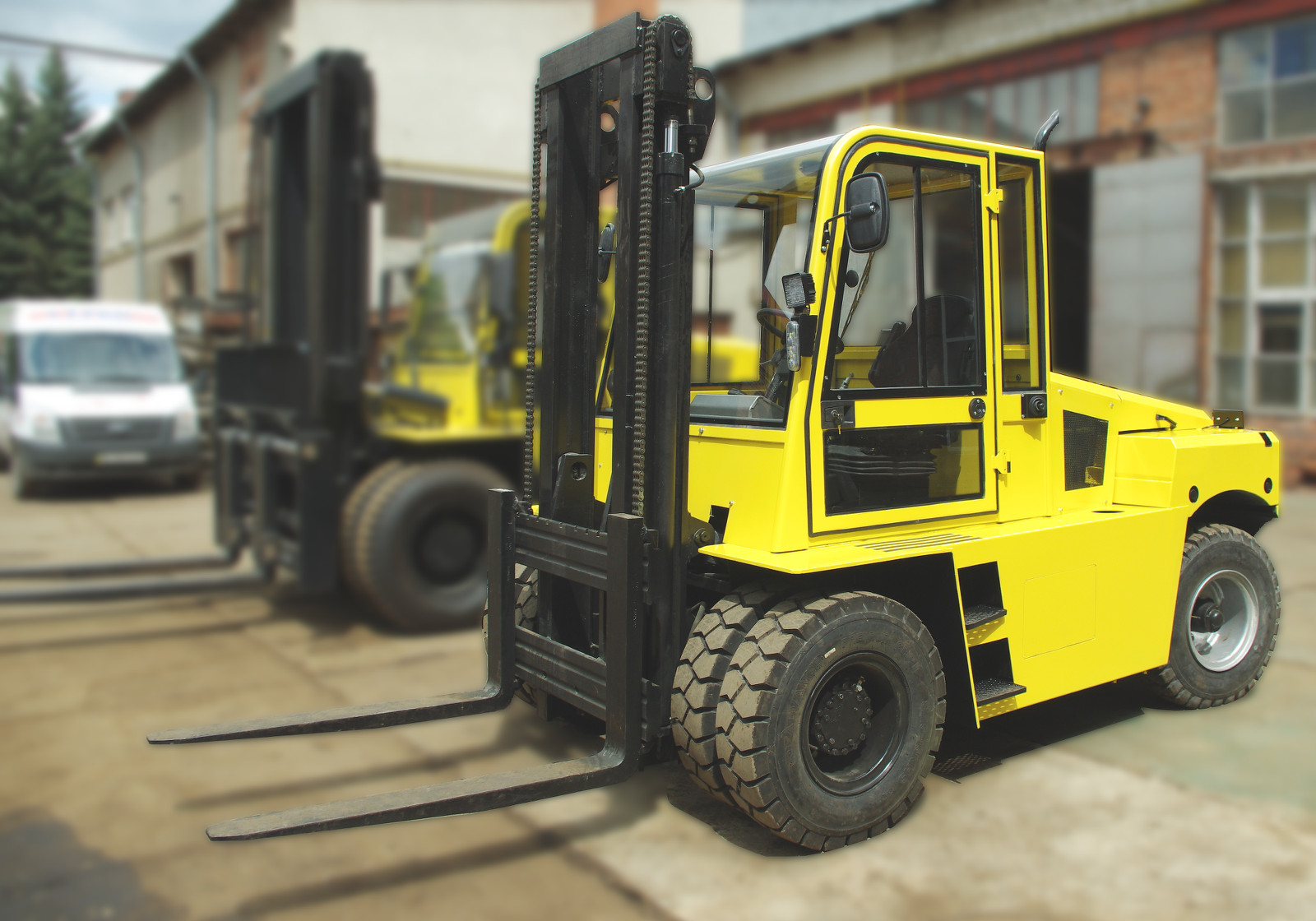
Lviv diesel forklift of in-house production, MF series (MF 70N)
The facts speak for themselves. The new MF-series diesel forklifts of our own production are proof of this. But that is a different story.
The article was prepared with the support of:
Stepan Mykhailovych Havrylechko (Chief Designer of LZA from 1986 to 2012), now the Chief Consultant in the role of Designer at Mikro-F.
The article uses materials from open information sources.
Photographs used are from the H. S. Pshenychnyi Central State CinePhotoPhono Archives of Ukraine.
When quoting (copying) materials from this article, a direct link to the website (article) is required.


 En
En